

Revenue cycle leaders have spent years strengthening back-end denial management, improving follow-up workflows, and refining appeal processes. While those efforts still matter, they don’t create a sustainable revenue stream. More of the risk that ultimately affects revenue forms earlier in the revenue cycle, before a claim is submitted and before a denial ever appears in a work queue. For many organizations, the most important opportunity is no longer recovering revenue. It is recognizing where revenue risk occurs while teams still have time to act.
Building pressures mid-cycle 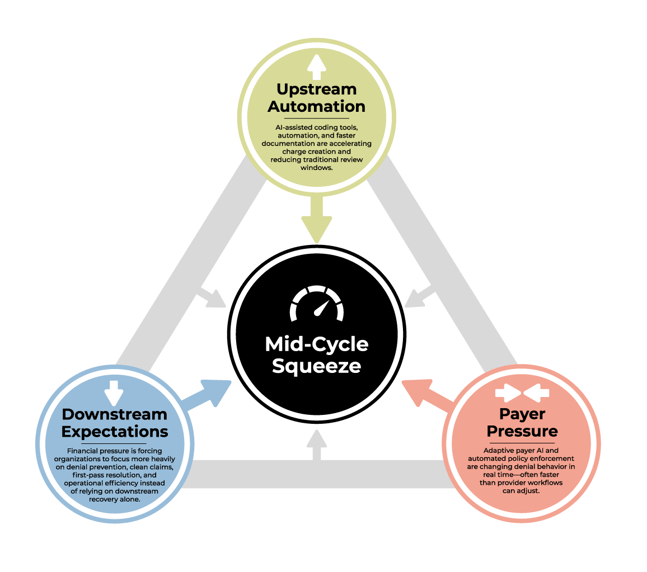
The middle of the revenue cycle — where documentation, coding, charge review, payer requirements, prior authorization, and claim readiness intersect — is often where pressure begins to build. When clinical, operational, and financial details are not aligned before a claim moves downstream, the result is familiar: avoidable rework, delayed payment, preventable denials, and teams spending valuable time correcting issues that could have been addressed earlier.
Teams feeling the squeeze are not alone. MGMA recently described revenue cycle leaks across multiple points in the process. In a recent MGMA poll, 48% of medical practices identified denials and appeals as the biggest revenue cycle leak, but the results also showed that risk is spread across several operational areas and not isolated to one single failure point. That matters because it reinforces what many revenue cycle leaders already see in practice: revenue leakage is often the result of a chain reaction, not one disconnected error.
Small issues, large costs
The mid-cycle has become the point where that chain reaction can either be interrupted or allowed to continue. A documentation gap can become a coding issue. A coding issue can become a charge accuracy problem. A charge accuracy problem can become a payer edit, rejection, denial, or delayed payment. And by the time the issue reaches the back end, the organization may still be able to appeal or correct the denial, but the cost of resolution has compounded by adding staff time and delayed A/R.
For revenue cycle leaders, this is why earlier intervention matters. The goal is not to review every claim manually or add more steps to an already complex process, but to identify the issues most likely to create downstream friction and address them while teams still have options. When organizations can catch preventable problems before submission, they reduce avoidable rework and give staff more time to focus on the exceptions that require human intervention.
Visibility improves controls
Once revenue risk moves downstream, teams have fewer options and more work to do. Earlier visibility changes that dynamic by helping organizations understand where issues are forming, which problems are likely to create delays or denials, and how staff should respond before avoidable work compounds.
This does not mean every issue can be prevented or every claim can move through the cycle without intervention. It means leaders need a better way to distinguish routine issues from complex exceptions, identify patterns before they become recurring problems, and focus human expertise where it has the greatest financial impact. The goal is not to add more noise to already busy teams, rather give clearer direction before preventable work becomes unavoidable work.
Reducing denial risk
The mid-cycle squeeze is a signal that revenue cycle performance is changing. Organizations that rely only on downstream recovery will continue to face revenue delays, payer friction, and staff time spent resolving issues that could have been addressed sooner. Organizations that build stronger visibility earlier in the cycle are better positioned to protect revenue, reduce unnecessary manual effort, and help teams act before small issues become larger financial and operational problems.
Download Rev Cycle Reinvented to learn how revenue cycle leaders can move risk detection earlier, strengthen mid-cycle visibility, and build a more proactive approach to revenue performance.