

The rapid evolution of AI and automation has transformed how healthcare organizations manage documentation, coding accuracy, and reimbursement processes. As regulations tighten and administrative burdens grow, providers are increasingly turning to software designed to automate medical coding to improve precision, reduce manual work, and accelerate claim submission.
Today’s leading platforms blend machine learning, natural language processing (NLP), and workflow automation to interpret clinical documentation, suggest accurate codes, and streamline coder productivity. The tools in this list represent a mix of established vendors and innovative technologies reshaping the medical coding landscape.
Below, we explore the top 10 software solutions to automate medical coding, their benefits, and what organizations should consider before investing in one.
Top 10 software to automate medical coding for 2026
1. Aptarro
2. Optum
3. Solventum
4. Dolbey
5. Nuance
6. Clinisys
7. TruBridge
8. Availity
9. RapidClaims
10. Athenahealth
What Is Automated Medical Coding?
Automated medical coding refers to the use of advanced technology (typically AI, NLP, and automation) to analyze clinical documentation and convert it into standardized medical codes. These systems review provider notes, extract clinical concepts, and support coders in producing accurate, compliant results. This process reduces manual workload and minimizes coding errors, enabling faster reimbursement and more consistent documentation quality.
Before exploring the software tools, here is a simplified overview of how automated medical coding works:
| Component | Description |
| Documentation Input | Clinical notes, electronic health record (EHR) entries, and diagnostic reports sent for processing |
| Data Extraction | AI identifies key terms, diagnoses, procedures, and clinical concepts |
| Code Mapping | The system matches extracted concepts to International Classification of Diseases (ICD), Current Procedural Terminology (CPT), and Healthcare Common Procedure Coding System (HCPCS) codes |
| Validation | Coders review, edit, and validate suggested codes |
| Submission | Codes are finalized and sent into the billing and claims workflows |
In summary, automated medical coding helps organizations bridge the gap between complex clinical documentation and standardized billing practices. By combining human oversight with intelligent automation, these systems create a faster, more reliable coding process that benefits both coders and healthcare providers.
What Is Automated Medical Coding Software?
Automated medical coding software is a specialized technology platform designed to accelerate and simplify the coding process. These tools use machine learning, natural language understanding, and embedded rules engines to suggest accurate codes and reduce manual tasks. Many integrate directly into EHR or revenue cycle management (RCM) systems to support end-to-end documentation and billing workflows.
These platforms vary by features and complexity; some are standalone coding engines, while others form part of larger revenue cycle systems. Their primary goal is to support coders, reduce error rates, ensure compliance, and improve reimbursement timelines.
Here’s a quick table summarizing the typical capabilities of automated medical coding software:
| Feature | Function |
| AI-Assisted Coding | Suggests codes based on note interpretation |
| NLP Processing | Reads provider notes and extracts clinical concepts |
| Compliance Support | Flags potential errors or missing documentation |
| Integration | Connects with EHR/RCM systems |
| Reporting | Offers analytics on coder productivity and code accuracy |
Overall, automated clinical coding software is essential for modern healthcare organizations aiming to improve efficiency, accuracy, and compliance. These platforms provide a foundation for smarter, data-driven coding decisions, supporting both small practices and large hospital systems alike.
Top 10 Software to Automate Medical Coding for 2026
Here are the best AI-powered platforms for medical coding, trusted by healthcare providers for their reliability and consistent accuracy rates.
1. Aptarro
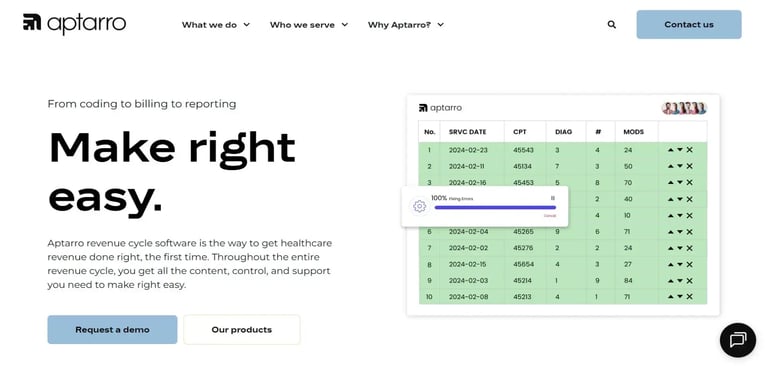
Aptarro stands out as a leading solution for organizations seeking a comprehensive approach to automating medical coding. Its platform, centered around the RevCycle Engine, offers a modern, integrated environment that combines automation, analytics, and expert insight to support coding teams efficiently. The platform provides a broad perspective across coding workflows and revenue cycle management, helping organizations optimize operations while reducing administrative strain.
What differentiates Aptarro is its focus on blending technology with strategic support. While it leverages AI and automation, it emphasizes human oversight, ensuring coding accuracy and reliability. Healthcare organizations value this balance as it allows teams to handle high volumes of documentation without sacrificing compliance or quality.
By adopting Aptarro, organizations can streamline operations, gain better visibility into revenue cycle performance, and support coders with intelligent guidance. Its end-to-end approach makes it the most robust option in today’s market. If you want to see how Aptarro can transform your coding process, book a demo today.
2. Optum
Optum leverages AI-driven coding suggestions to help coders navigate complex documentation efficiently. The platform integrates with EHRs and provides compliance checks to reduce errors and accelerate claim submission.
3. Solventum
Solventum uses NLP and speech recognition to interpret provider narratives and assist coders. It supports both inpatient and outpatient coding workflows, improving the accuracy of patient data.
4. Dolbey
Dolbey applies advanced clinical language understanding to recommend codes. Its auditing capabilities help healthcare organizations reduce denials and improve coding accuracy across multiple specialties.
5. Nuance
Nuance offers AI-assisted documentation analysis and coding support. The system identifies clinical indicators, suggests codes, and helps coders maintain documentation completeness.
6. Clinisys
Clinisys provides automated extraction and mapping tools to help hospitals improve coding turnaround times. Its workflow support promotes consistent output and reduces administrative delays.
7. TruBridge
TruBridge offers coding assistance designed for rural hospitals and smaller health systems. Its automation features streamline documentation review and support consistent coding practices.
8. Availity
Availity’s suite includes automation tools to assist with documentation review and code suggestions. The platform focuses on improving workflow efficiency between providers and payers.
9. RapidClaims
RapidClaims provides AI-driven medical coding and claims automation to improve accuracy and streamline workflows. It helps reduce administrative burden and accelerate claim processing.
10. Athenahealth
Athenahealth’s coding support is integrated into its EHR ecosystem. It helps identify key documentation elements and assists with code selection to reduce manual work for coders.
Benefits of Automated Medical Coding Software
Adopting automated coding software offers organizations measurable improvements in efficiency, accuracy, and workflow management. Here’s a closer look at the primary benefits:
Improved accuracy
Automation reduces human error by interpreting clinical documentation consistently and highlighting missing or unclear information. This leads to cleaner claims, fewer denials, and more reliable reimbursements.
Increased coder productivity
By handling repetitive tasks and suggesting codes, the software allows coders to focus on more complex cases. This improves throughput and enables teams to process higher volumes of documentation efficiently.
Reduced administrative burden
Automated systems minimize manual data entry and review, lightening the workload for coding teams. This allows staff to focus on higher-value tasks and reduces operational bottlenecks.
Key Features of Automated Medical Coding Software
Modern automated medical coding software includes features designed to enhance coder workflows, ensure compliance, and integrate seamlessly with healthcare IT systems.
AI and NLP processing
Artificial intelligence and NLP technologies analyze unstructured provider notes, extract relevant clinical information, and suggest accurate codes. Strong NLP capabilities are essential for handling diverse documentation styles.
Real-time compliance support
Embedded rules engines flag potential errors and ensure coding practices adhere to regulatory requirements, helping maintain audit readiness.
Seamless interoperability
Leading platforms integrate directly with EHR and RCM systems, enabling smooth data flow and minimizing duplicate work across coding and billing workflows.
What to Consider When Purchasing Automated Medical Coding Software
Before selecting a platform, healthcare organizations should evaluate their coding needs, integration requirements, and long-term scalability. In particular, it is worth reflecting on:
Level of automation needed
Determine whether your organization requires full computer-assisted coding capabilities or partial assistance for select documentation types. Volume and complexity of cases will guide the choice.
Integration and workflow compatibility
The software should work seamlessly with existing EHR, billing, and documentation systems. Poor integration can undermine automation benefits and create workflow friction.
Scalability and long-term value
To ensure long-term return on investment (ROI), choose a solution that can accommodate growing data volumes, support multiple specialties, and evolve with regulatory changes.
Driving Smarter, Faster Coding Operations
Automated medical coding has evolved from a luxury into an essential capability for healthcare providers who are serious about improving efficiency, accuracy, and reimbursement performance. When teams leverage intelligent automation effectively, they can dramatically reduce errors and accelerate workflows, which frees up coders to focus on the complex, high-value work that truly requires human expertise.
What sets our first choice, Aptarro's RevCycle Engine, apart is its comprehensive approach, one that thoughtfully combines automation with expert oversight rather than simply replacing human judgment.
Healthcare providers who have adopted this platform consistently report improved coding accuracy alongside enhanced visibility into their workflow performance, leading to more optimized revenue cycle operations across the board.
If you’re ready to take your coding process to the next level, book a demo with Aptarro today and see how its intelligent automation platform can support your organization’s success.