

Revenue Cycle Management (RCM) remains one of the most critical operational pillars in healthcare. As providers navigate shifting payer rules, rising patient financial responsibility, and ongoing regulatory pressure, the ability to maintain a healthy and predictable revenue cycle is more important than ever. Organizations that rely on outdated, manual, or disconnected financial workflows are finding it increasingly difficult to stay efficient and profitable.
In 2026, RCM solutions are stepping into a new era. Rather than functioning as simple billing tools, today’s platforms integrate intelligence, automation, and real-time visibility to strengthen every financial touchpoint. They help reduce administrative friction, prevent avoidable denials, and give teams the clarity needed to drive measurable financial improvement.
This guide highlights the top 10 RCM solutions shaping the industry in 2026. You will learn what RCM is, how RCM solutions differ from traditional processes, and how each of the leading vendors supports modern revenue cycle needs. Whether you are seeking to replace outdated systems or evaluate new technology, this list will help you make a more informed choice.
Top 10 RCM solutions for 2026
1. Aptarro
2. Waystar
3. Athenahealth
4. Epic
6. R1 RCM
8. ModMed
9. Optum
10. FinThrive
What Is RCM?
Revenue Cycle Management (RCM) refers to the complete set of financial and administrative processes involved in capturing, managing, and collecting revenue across a patient’s care journey. It begins long before a service is provided and continues until the account is fully resolved. RCM ensures that every step (from scheduling and documentation to coding, claims submission, and payment collection) is accurate, compliant, and efficient.
RCM is not a single task but an interconnected financial workflow. Each component contributes to your organization’s ability to get paid correctly and on time. Issues such as inaccurate patient data, incomplete documentation, or coding errors can significantly impact reimbursement. A well-managed RCM process, on the other hand, helps healthcare organizations strengthen financial stability, reduce revenue leakage, and maintain operational control.
Below is a table summarizing the foundational components of RCM:
| Component | Description |
| Patient Access | Completion of registration, insurance checks, and financial discussions before the visit. |
| Clinical Documentation | Accurate recording of services that determine how claims are coded and billed. |
| Coding and Charge Capture | Translating services into standardized codes and ensuring all billable items are captured. |
| Claims Processing | Preparing, validating, and submitting claims to payers for reimbursement. |
| Payments and Collections | Posting payments, addressing discrepancies, and collecting remaining patient balances. |
| Performance Analytics | Monitoring trends in denials, Accounts Receivable (AR), and reimbursement to guide improvement. |
A well-structured RCM process lays the foundation for healthy revenue cycles, ensuring that clinical, administrative, and billing activities remain aligned.
What Is RCM Solutions?
RCM Solutions refer to the digital platforms, tools, and technologies designed to manage and streamline the revenue cycle. While RCM describes the overall financial process, RCM solutions represent the systems that support, automate, and monitor those workflows. These platforms help organizations reduce manual work, maintain consistency, and identify financial risks much earlier in the process.
Unlike traditional billing software, modern RCM solutions provide a more integrated and proactive approach. They centralize tasks, consolidate data across teams, and offer visibility into financial performance. Whether used by small practices or large health systems, RCM solutions help ensure that processes are efficient, compliant, and easily scalable, even while payer rules and patient expectations evolve.
Below is an overview of the elements typically included in RCM solutions:
| Element | Description |
| Eligibility and Coverage Tools |
Systems that verify insurance and benefits. |
| Coding and Documentation Support | Tools that assist with translating clinical notes into compliant codes. |
| Claims Review and Validation | Processes that identify errors or missing data before claims are sent. |
| Payment and Reconciliation Tools | Platforms that track payments and match them to the correct accounts. |
| Denial Monitoring | Systems that track issues impacting reimbursement and support corrective actions. |
| Financial Insights and Reporting | Dashboards that highlight revenue trends and operational performance. |
Strong RCM solutions provide structure, consistency, and clarity. When implemented effectively, they help organizations reduce avoidable errors, improve payment predictability, and create a more stable financial environment.
Top 10 RCM Solutions for 2026
1. Aptarro
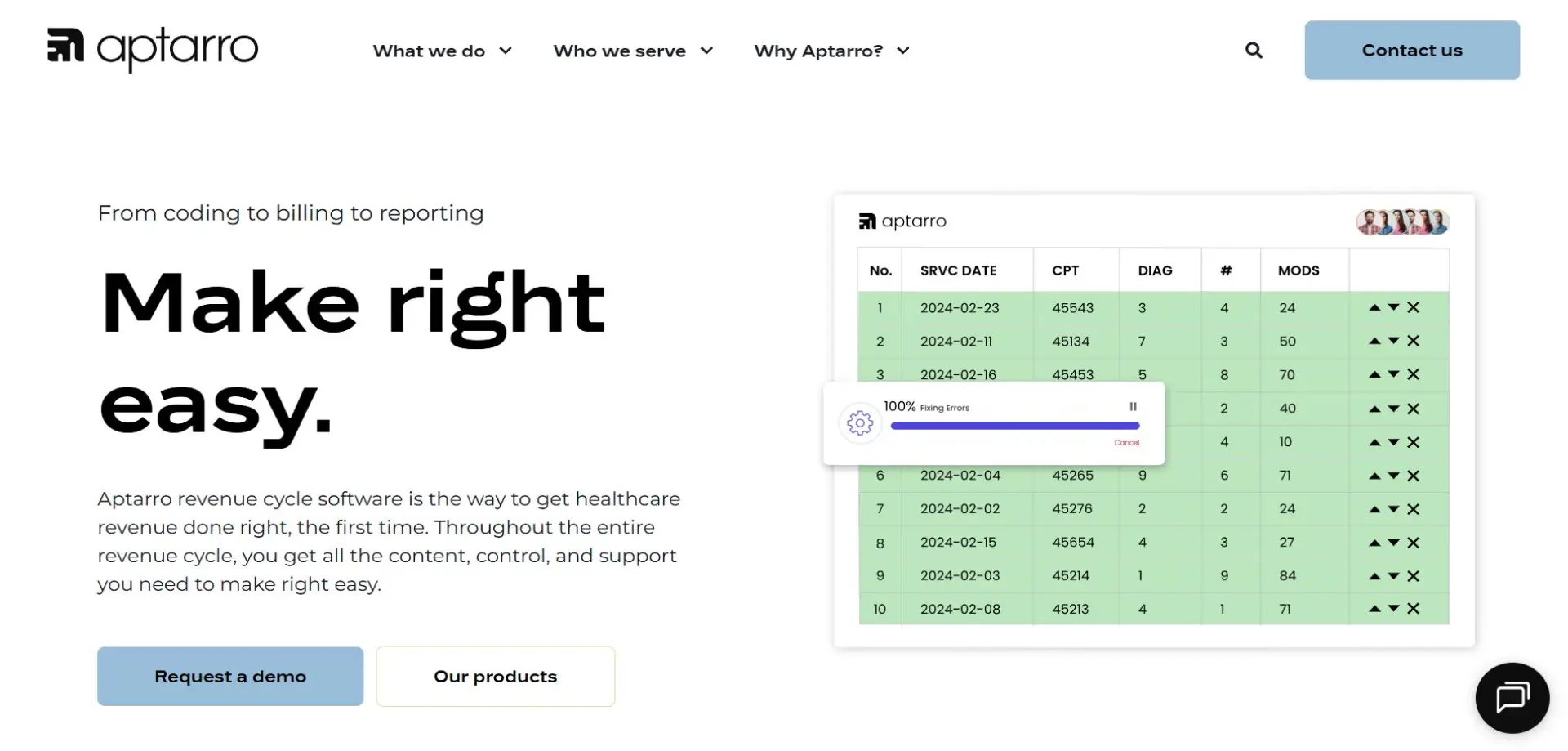
Aptarro stands at the top of the list for 2026, offering one of the most comprehensive and intelligently designed RCM solutions available today. Built with modern healthcare challenges in mind, Aptarro streamlines the financial journey from patient access through final reimbursement. Its approach centers on improving accuracy, minimizing revenue leakage, and enabling organizations to maintain tighter financial control.
A key part of Aptarro’s platform is its RevCycle Engine: an advanced software foundation designed to strengthen revenue cycle performance through automation, consistency, and real-time financial insight. Besides its robust technology, what truly sets it apart is its ability to help organizations maintain efficient workflows without adding operational complexity. It facilitates by supporting teams with structured, repeatable processes that increase accuracy while reducing administrative strain.
Providers looking for a scalable, intelligent RCM solution value Aptarro for its blend of technology, visibility, and user-friendly workflows. Healthcare organizations seeking a modernized approach to financial operations will find Aptarro especially well-suited to long-term efficiency and growth. Book a demo to see how Aptarro can support your RCM transformation.
2. Waystar

Waystar offers a user-friendly financial platform that supports streamlined claims, payment management, and administrative workflows. It is recognized for its clarity, ease of adoption, and strong payer connectivity.
3. Athenahealth

Athenahealth provides a revenue cycle suite that emphasizes ongoing performance monitoring and workflow consistency. Its platform is commonly used by practices looking for synchronized clinical and administrative processes.
4. Epic
Epic is built for organizations that require an enterprise-level financial infrastructure. It supports cross-department coordination and provides broad oversight of complex billing workflows.
5. Oracle Health
Oracle Health (formerly Cerner) delivers revenue cycle tools designed to support large health systems with multifacility needs. The platform helps centralize financial operations across multiple care settings.
6. R1 RCM
R1 RCM provides technology-enabled services and financial tools for hospitals and health systems. Its platform helps streamline patient access, billing, and claims workflows while supporting more efficient revenue cycle operations.
7. Experian Health

Experian Health offers solutions for eligibility verification, claims management, and patient collections. Its data-driven tools help organizations maintain accurate billing and improve financial performance across high-volume operations.
8. ModMed

ModMed offers RCM solutions tailored to specialty practices. Its platform integrates documentation and financial processes to support specialty-specific workflows while helping practices manage billing and collections efficiently.
9. Optum
Optum provides enterprise-level RCM tools covering patient intake, billing, and administrative processes. The platform is widely used by hospitals and health systems to increase operational efficiency and maintain financial visibility.
10. FinThrive
FinThrive offers technology to help healthcare organizations improve claims management, payer contracting, and financial performance monitoring. Its platform supports organizations in reducing errors and optimizing revenue cycle operations.
Benefits of RCM Solutions
Modern RCM solutions offer meaningful advantages for healthcare organizations looking to strengthen their financial processes. These benefits apply across organizations of all sizes and specialties.
Improved reimbursement speed
Faster, more predictable payments result from streamlined workflows and more accurate financial data. RCM solutions help organizations reduce slowdowns caused by preventable errors and administrative roadblocks.
Higher clean-claim rates
With structured processes in place, organizations can reduce the number of claims that require correction or rework. This leads to fewer interruptions, better productivity, and increased first-pass success.
Reduced administrative burden
By simplifying financial tasks and centralizing workflows, RCM solutions reduce the pressure on staff. Teams can focus more on high-value tasks and less on manual, repetitive processes.
Clearer financial visibility
Having centralized data and consistent financial reporting allows leaders to understand performance trends and identify areas that require attention. This visibility supports stronger long-term planning.
Key Features of RCM Solutions
RCM solutions often include specific capabilities that support financial efficiency and stability. While these features vary by platform, most modern systems share a similar core focus.
Real-time eligibility verification
By confirming coverage before a visit occurs, organizations reduce the likelihood of claim rejections caused by inaccurate or incomplete insurance information.
Automated coding and charge capture
Supportive tools help ensure services are documented and coded correctly, helping maintain compliance and billing accuracy.
Advanced claim scrubbing
By identifying inconsistencies or missing elements before claims go out the door, organizations reduce denied claims and protect the revenue cycle from delays.
Comprehensive denial management
Integrated monitoring and workflows help staff respond quickly to denied claims and identify the root causes behind recurring issues.
What to Consider When Purchasing RCM Solutions
Choosing the right RCM solution requires careful evaluation of your organization’s unique needs, resources, and growth plans. Taking time to assess key considerations ensures better long-term alignment.
Integration with your existing systems
Smooth integration between your RCM solution, EHR, and administrative systems ensures accurate data flow and reduces manual entry.
Scalability for future growth
A platform should be able to support expanding patient volumes, new providers, or additional service lines without creating operational strain.
Ease of use and training requirements
The more intuitive the system, the easier it is for staff to learn how to use it. Accessible platforms improve efficiency and reduce training time.
Vendor support and reliability
Strong customer support helps address issues quickly and keeps operations running smoothly, especially during go-lives or process changes.
Strengthening Financial Performance Through Smarter RCM
The right RCM solution can transform the way healthcare organizations manage and protect their revenue. As financial pressure continues to rise, having tools that support accuracy, efficiency, and visibility is no longer optional. It is essential for long-term stability. The RCM solutions highlighted in this list represent the platforms shaping the financial future of healthcare in 2026.
If your organization is preparing to modernize its revenue cycle, now is the time to evaluate the tools that best match your goals. A well-implemented RCM solution can reduce errors, streamline operations, and improve overall financial health.
Ready to see how a modern RCM solution can support your growth? Book a demo today.